Inside the R&D Shift: Vol. 1

Updated: Aug 25

Creating This Week’s Speakeasy Cocktails
Eight hours. Two new cocktails. Syrups to make, recipes to test, batches to build, bottles to label, a bar to clean, and by the end of it, everything has to be ready for service.
Welcome to Inside the R&D Shift, a new Saints & Spirits series where I pull back the curtain on what actually goes into creating cocktails for a working speakeasy.
Every week, I step into R&D knowing that by the end of the shift, new cocktails need to be ready for the weekend menu.
And I’ve been doing it for more than four years.
As the lead mixologist at Melinda’s Alley in downtown Phoenix, creating new drinks isn’t something I occasionally get to do. It’s part of the job. Week after week, I’m testing ingredients, building syrups, adjusting recipes, tasting, failing, rebuilding, batching, labeling, and eventually watching those experiments make their way into guests’ hands.
Some drinks start with one ingredient I can’t stop thinking about.
Others come from combining techniques and flavor combinations I’ve used before into something completely new.
This week gave me one of each.
A bright blueberry, lavender, and limoncello vodka cocktail with an unexpected hint of peppermint.
And a bold purple ube and toasted coconut rum cocktail built from the ground up around an ingredient I’d been wanting to use for a while.
Here’s how they came together.
First, What Does an R&D Shift Actually Look Like?
One thing people don’t always realize about cocktail development is how much work happens before a finished drink ever reaches the bar.
I typically come into R&D with some kind of direction already in mind.
You almost have to.
We have roughly eight hours to develop two cocktails, and during that same shift we may need to create syrups, cordials, or infusions, test multiple versions, finalize the recipes, scale everything for service, batch the cocktails, label everything, and clean the entire workspace.
Sometimes eight hours isn’t enough.
There is a lot of pressure involved in producing new cocktails every single week, especially when the drinks can’t simply be creative.
They also have to taste good, be repeatable, work during high-volume service, and give the guest something worth remembering.
That’s where having a direction before R&D becomes important.
This week’s two cocktails are good examples of two completely different ways I approach creating a drink.
Cocktail No. 1: Building Something New From Familiar Ideas

For the vodka cocktail, I didn’t start with one completely new concept.
Instead, I started connecting pieces.
Vodka + Limoncello
One split base I come back to with vodka is vodka and limoncello.
At the hotel, we have access to a local limoncello called Chelly, which I especially like working with because it isn’t overly sweet. It has a little more proof behind it and carries subtle lavender notes that make it much more interesting to build around.
That gave me my foundation.
But vodka, limoncello, and fruit alone weren’t enough.
I wanted another layer.
Stop Sleeping on Vermouth
I love using vermouth and aromatized wine in vodka and gin cocktails.
Vermouth might be one of the most slept-on tools behind the bar.
People often associate it almost exclusively with Martinis, but even a relatively small amount
can completely change the way a cocktail develops on your palate.
Vermouth brings herbs, botanicals, wine, bitterness, and complexity.
More importantly, it can bridge flavors together.
I don’t want a cocktail to hit you with one flavor and then disappear.
That’s boring.
I want a beginning.
A middle.
An ending.
Maybe even a little cliffhanger.
Something you notice on the first sip, something different you discover halfway through, and another flavor that hangs around after you’ve already put the glass back down.
Ingredients like vermouth, Cocchi Americano, and other aromatized wines are incredible tools for creating those transitions.
For this drink, I went with Dolin Dry Vermouth.
Blueberry Takes the Lead
I already had lavender syrup prepared, so I decided to use a small amount to reinforce the subtle floral notes coming from the limoncello.
But lavender wasn’t going to be the main flavor.
I wanted blueberry front and center.
A bright house blueberry cordial gave the cocktail its color and primary fruit character, while fresh lemon reinforced the acidity and kept everything vibrant.
At this point, the drink was good.
But it still needed something.
And sometimes the ingredient that finishes a cocktail isn’t the obvious one.
Then Came the Peppermint Schnapps
This was the left-field decision.
A bar spoon of peppermint schnapps.
Peppermint and blueberry isn’t necessarily the first pairing someone would write down when developing a cocktail.
That’s exactly why I wanted to try it.
And it ended up being one of my favorite parts of the drink.
At that amount, the peppermint doesn’t turn the cocktail into a candy cane.
Instead, it appears at the very end.
Blueberry hits first.
Then citrus, herbs, and florals move through the middle.
And finally there’s this light cooling peppermint note that slowly fades away.
That’s the cliffhanger.
A dash of saline helped pull everything together, and the cocktail was served up in a Nick &
Nora with expressed lemon oils and a Luxardo cherry resting at the bottom of the glass.
Approachable.
Bright.
Easy to drink.
But with enough going on underneath the surface to keep the next sip interesting.
The Final Build
Blueberry, Lavender & Limoncello Vodka Cocktail
.75 oz Tito’s Vodka
.75 oz Chelly Limoncello
.50 oz Dolin Dry Vermouth
1.25 oz blueberry cordial
.25 oz lavender syrup
.75 oz fresh lemon juice
1 bar spoon peppermint schnapps
1 dash saline
Method: Shake with ice and double strain into a chilled Nick & Nora.
Finish: Express a lemon peel over the cocktail and discard. Drop one Luxardo cherry into the bottom of the glass.
Cocktail No. 2: Start With the Ingredient

The rum cocktail came together completely differently.
This time I knew exactly where I wanted to start.
Ube.
I’d been wanting to play with it, so instead of building a rum cocktail and figuring out where ube might fit, I did the opposite.
Everything had to earn its place around the ube.
Ube naturally has this beautiful earthy sweetness with vanilla-like qualities, so vanilla immediately became part of the direction.
From there I started thinking about flavors that naturally made sense around it.
Coconut.
Vanilla.
White chocolate.
Orange.
Rum.
Now we had somewhere to go.
Building the Ube Syrup
I used ube extract and leaned further into its vanilla character by adding vanilla bean paste.
Then I brought in toasted coconut.
Toasting the coconut was important because I didn’t just want generic coconut sweetness.
Toasting introduces a deeper, nuttier flavor that gives the syrup more dimension.
Ube extract, toasted coconut, vanilla bean, and a little salt became the foundation.
And the color?
Bright purple.
Before the cocktail even reaches your mouth, it already has personality.
Building Around It
For the spirit, I wanted rum to remain firmly in control of the cocktail.
So I went with a heavy 2 oz pour of light rum.
Then came one of my favorite little tricks when building rum drinks:
a bar spoon of Smith & Cross Jamaican Rum.
You don’t always need a large amount.
That little touch of high-proof Jamaican rum introduces some funk and character without hijacking the entire drink.
Next came .25 oz dry curaçao.
Why orange?
Because once I had ube, vanilla, toasted coconut, and white chocolate working together, orange made sense.
Cocktail development doesn’t always need to begin with another cocktail.
Sometimes it starts by thinking about food.
What naturally tastes good together?
Vanilla and orange.
Coconut and lime.
White chocolate and vanilla.
Rum and tropical flavors.
Once those connections start forming, the cocktail begins telling you where it wants to go.
A small .25 oz of white chocolate syrup reinforced the richer dessert-like qualities without turning the drink into a sugar bomb.
Then .75 oz fresh lime juice brought the brightness and acidity everything needed.
A dash of saline tightened it all up.
The cocktail was dirty dumped into the glass, finished with pebble ice, and garnished with an orchid.
The result was bright purple, tropical, rich, refreshing, and deceptively easy to drink.
And with 2 oz of light rum plus that bar spoon of Smith & Cross?
It packs a punch.
The Final Build
Ube, Toasted Coconut & Rum
2 oz light rum
1 bar spoon Smith & Cross Jamaican Rum
.25 oz Dry Curaçao
1.25 oz toasted coconut ube syrup
.25 oz white chocolate syrup
.75 oz fresh lime juice
1 dash saline
Method: Shake with ice and dirty dump into the glass.
Finish: Top with pebble ice and garnish with an orchid.
Two Cocktails. Two Completely Different Creative Processes.
That’s probably my favorite part about developing cocktails.
There isn’t one correct way to create one.
The vodka cocktail was almost like working with pieces of a puzzle.
I took a split base I already knew I liked, ingredients I had available, techniques I’d used before, and flavor combinations I understood, then started connecting them.
The unexpected peppermint addition gave the drink its new identity.
The rum cocktail was the opposite.
Ube came first.
Once I decided that was the star, I built an entire world around it.
Vanilla.
Toasted coconut.
White chocolate.
Orange.
Lime.
Rum.
Two completely different roads that eventually ended in the same place:
a finished cocktail ready for the menu.
And both became top sellers over the weekend.
Four Years of Failing, Learning & Creating
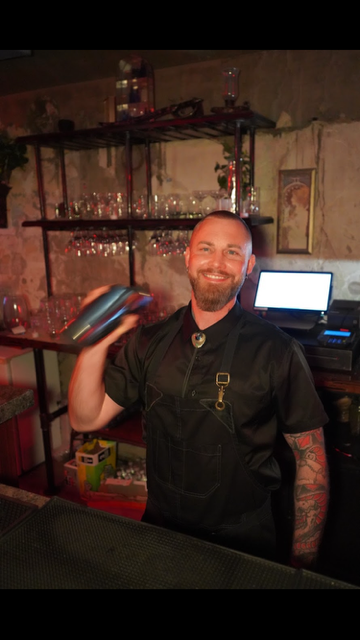
I’ve been developing new cocktails every week for more than four years.
That’s hundreds of drinks.
Some ideas work almost immediately.
Others absolutely do not.
Sometimes the ingredient you’re convinced will make the drink ends up being the first thing you remove.
Sometimes you’re several versions deep and realize you need to start over.
And every once in a while, you throw a bar spoon of peppermint schnapps into a blueberry cocktail and suddenly everything clicks.
That’s R&D.
My passion for this craft was built through that weekly challenge.
It forced me to create when I didn’t feel creative.
It forced me to understand why something wasn’t working instead of simply saying it didn’t taste good.
It taught me how to balance cocktails faster, how to trust my palate, and probably most importantly, how to fail without being afraid of failing.
I also get another opportunity to create through our daily bar ritual at the Renaissance
Phoenix Downtown Hotel, constantly putting new combinations in front of guests and seeing how people respond.
The repetitions add up.
Create. Taste. Adjust. Fail. Learn. Repeat.
Practice really does matter.
I’m fortunate to have had an environment where I’ve been able to do that over and over again, and those years behind the bar have shaped the mixologist I am today.
Inside the R&D Shift Is Just Getting Started
This is only Volume 1.
There are hundreds of cocktails behind me and plenty more that haven’t been created yet.
Inside the R&D Shift will be an ongoing Saints & Spirits series where I share selected drinks from behind the speakeasy bar: the ideas, experiments, failures, techniques, and final recipes that make it onto the menu.
Because the finished cocktail is only part of the story.
Sometimes the more interesting part is figuring out how we got there.
Want More Recipes, R&D Stories & Behind-the-Bar Content?
Join the Saints & Spirits Community for more cocktail recipes, techniques, behind-the-
scenes R&D, and everything happening at Saints & Spirits.
Bring the Saints & Spirits Experience to Your Next Event
Looking for more than someone who can simply pour drinks?
Saints & Spirits brings custom cocktail development, professional bartending, house-made ingredients, and a true craft cocktail experience directly to your event.



Comments